Why the operating room is part of the device protocol
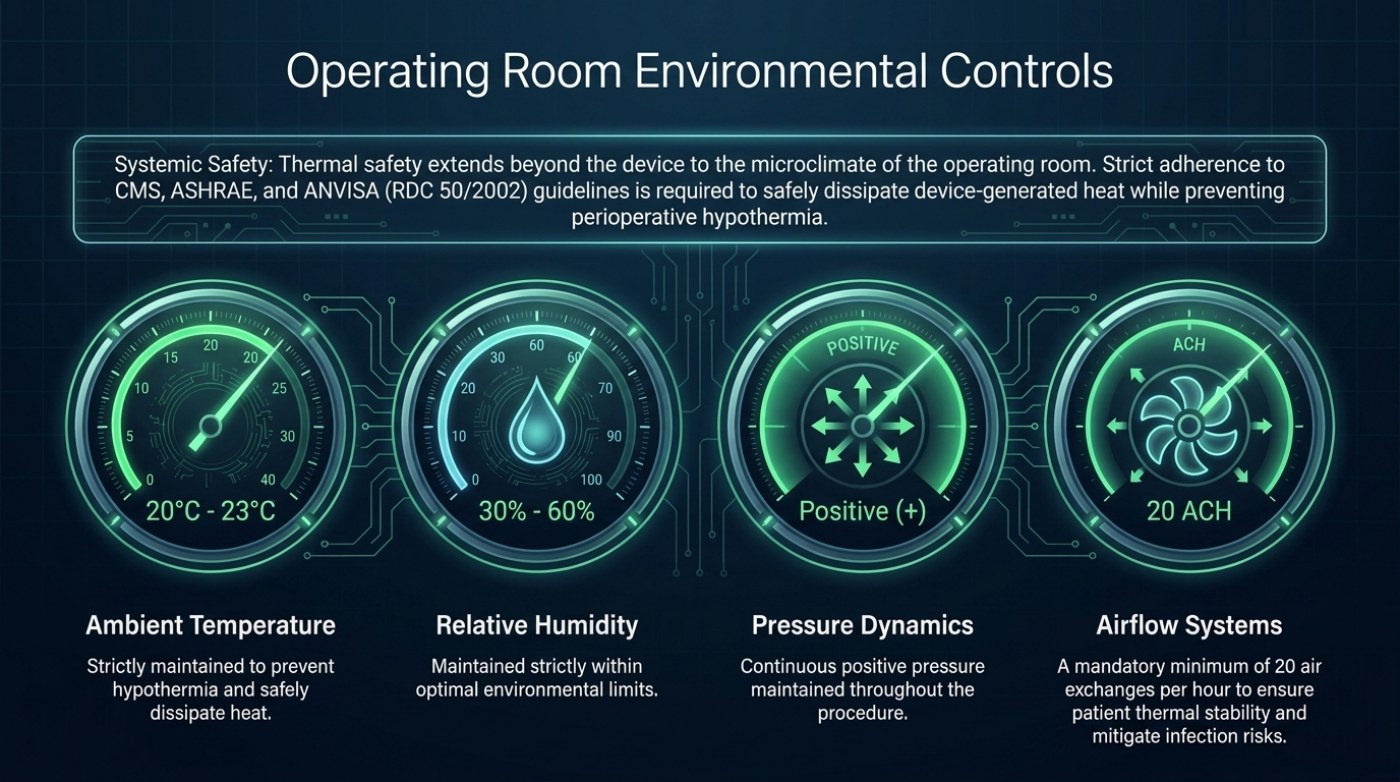
The eighth slide moves the safety argument off the patient and into the room. Its opening panel states the position: thermal safety extends beyond the device to the microclimate of the operating room, and strict adherence to published standards is required to dissipate device-generated heat safely while preventing perioperative hypothermia. Both halves of that sentence are about temperature, but they point in opposite directions — energy devices add heat to the situation, and an anaesthetised patient loses it. This is written for homeowners around Sarasota, FL who are looking into fat removal surgery and want the honest version rather than a sales page.
The short version
- The slide holds the operating room itself to four parameters: ambient temperature, relative humidity, pressure dynamics and air exchange rate.
- Ambient temperature is set at 20 to 23 degrees Celsius, a band held to prevent hypothermia and dissipate device-generated heat.
- Relative humidity is held between 30 and 60 percent, and the room runs at continuous positive pressure throughout.
- Airflow must deliver at least 20 air exchanges per hour, which supports thermal stability and lowers infection risk.
- The slide cites CMS, ASHRAE and ANVISA guidelines, so the values read as requirements rather than preferences.
That is the reason a slide about body contouring lists ambient temperature, relative humidity, pressure and air exchange rates. An energy-assisted procedure puts a heat load into a controlled space. The space has a specification. The specification has to hold for the duration of the case, not just at the start.
What the slide asks the room to hold
Four dials run across the slide, each one with a figure and a short rationale beneath it. Ambient temperature is set at 20 °C to 23 °C, described as strictly maintained to prevent hypothermia and to dissipate heat safely. Relative humidity is set at 30 % to 60 %, described as maintained strictly within optimal environmental limits. Pressure dynamics are shown as positive, with continuous positive pressure maintained throughout the procedure. Airflow systems carry a mandatory minimum of 20 air exchanges per hour, described as ensuring patient thermal stability and mitigating infection risks.
| Parameter | Value on the slide | Stated rationale |
|---|---|---|
| Ambient temperature | 20 °C – 23 °C | Strictly maintained to prevent hypothermia and safely dissipate heat |
| Relative humidity | 30 % – 60 % | Maintained strictly within optimal environmental limits |
| Pressure dynamics | Positive (+) | Continuous positive pressure maintained throughout the procedure |
| Airflow systems | 20 ACH | A mandatory minimum of 20 air exchanges per hour for patient thermal stability and infection-risk mitigation |
Two of these are directly about heat and two are about the air itself. Temperature and humidity are the ones a patient would recognise as an environment. Pressure and air changes per hour are the ones that are invisible during a procedure and are nevertheless how the room is classified and surveyed.
The guideline framework named on the slide
The slide's header names the standards it is working to: CMS, ASHRAE, and ANVISA (RDC 50/2002) guidelines. Naming them matters for a reader, because it turns a set of numbers from a preference into a requirement. The parameters on the four dials are not the deck's opinion about a comfortable room; they are values the deck presents as aligned with published standards for surgical environments.
| Standard named | Scope of the standard | Why the slide cites it |
|---|---|---|
| CMS | US federal conditions of participation for facilities that treat Medicare and Medicaid patients | Frames the environmental requirements as conditions a facility is expected to meet |
| ASHRAE | Ventilation and indoor air-quality engineering standards | Underpins the airflow and air-exchange figures rather than leaving them as custom |
| ANVISA (RDC 50/2002) | Brazilian health-regulatory standard for physical establishment design | Shows the parameter set is used across regulatory systems, not invented for one market |
The practical reading is that a facility's numbers should be checkable against a documented standard rather than reported on request. If an environmental claim is made about a room, the standard it is aligned with is the thing to ask about, and our own guide to verifying credentials and accreditation covers the facility side of that conversation.
The heat balance: why 20–23 °C is not arbitrary
The slide's rationale for ambient temperature names two jobs at once — preventing hypothermia and dissipating device-generated heat. A room that is too warm traps the energy platform's heat load; a room that is too cold drives the patient's core temperature down during a procedure that can run for hours. The stated band is the compromise, and the deck treats it as a band that is held rather than a starting condition.
| Requirement | Heat source it manages | Failure mode if it is not held |
|---|---|---|
| Ambient band of 20 °C – 23 °C | Device-generated heat entering the room | A room that cannot absorb the load, or a patient losing core temperature in a cold room |
| Relative humidity of 30 % – 60 % | Moisture content of the air | Falling outside the limits the slide describes as optimal for the environment |
| Continuous positive pressure | Airborne particles moving between spaces | Room air being replaced by air from adjacent, less controlled areas |
| Minimum 20 air exchanges per hour | Heat, humidity and airborne contamination together | Air that is neither exchanged nor conditioned fast enough to hold the other three values |
The coupling also explains why the slide lists airflow last. An exchange minimum is the mechanism that holds the other three parameters; without it, an ambient band and a humidity band are aspirational numbers on a wall. A room that is being surveyed against a documented standard is one where the values are maintained by the ventilation system rather than by the door being kept closed.
A second consequence is worth noting for anyone reading a facility's claims. Environmental conditions are properties of a room and a day, not of a brand or a technique. Two procedures performed with the same platform in two different rooms are not automatically performed under the same conditions, which is why the slide frames the requirement as adherence to published guidelines rather than as a feature of the device. The patient-facing version of that idea is simple: the conditions are checkable, and the standard the room is measured against is the thing to ask about. Our guide to verifying credentials and accreditation covers the same ground from the facility side.
The four dials are therefore coupled rather than independent. Air exchanges per hour are what make an ambient band and a humidity band maintainable in a room with an active heat load; positive pressure is what keeps the exchange happening with controlled air rather than borrowed air. Reading the slide as four separate set-points misses the point of putting them on one page.
Perioperative hypothermia is the other half of the safety case
The slide's own framing sentence names preventing perioperative hypothermia alongside dissipating heat, and that pairing is the interesting part. Energy-assisted body contouring is a long procedure on a patient who is, in most cases, under sedation or anaesthesia in a cooled room. The thermal protocol has to protect the tissue being treated and the patient's overall thermal state at the same time, and the slide treats the second as an environmental responsibility rather than a device setting.
Our published guide to heat-based tightening makes the same observation about the deck's figures from a different angle: the ambient band and the air-exchange minimum come from the same source material as the thermal target and the surface cap, and they are reproduced because they are the numbers the technique is described with — not because they were independently re-measured for that article. This article treats them the same way.
Questions this slide raises
Why does a body-contouring slide list air exchange rates?
Because the parameters are coupled. Device-generated heat has to go somewhere, a room holds a limited heat load, and the exchange rate is what moves air through it. The slide also names infection-risk mitigation as part of the rationale for the 20 ACH minimum, so the figure is serving the patient's thermal stability and the room's contamination control at once.
Is positive pressure about sterility or about temperature?
The slide states it as continuous positive pressure maintained throughout the procedure, with the environmental-control panel framing the whole page around heat dissipation and hypothermia prevention. Positive pressure is the mechanism that keeps the room's conditioned air in place instead of drawing in air from adjacent spaces, which is why it appears next to the airflow figure rather than on its own.
Do these numbers guarantee anything about a result?
No. They are environmental specifications, not outcome measures. What they represent is a facility holding documented conditions for the duration of a procedure — which is checkable — rather than a claim about how much skin will contract or how much fat will be removed. Our published material on the deck's figures is explicit that these values describe the conditions the technique is built on.
This is published information, not medical advice — a board-certified surgeon must assess whether a procedure suits you.
Related Guides
Three guides that continue this line of the deck:
- Liposuction Risks and Complication Rates as Published — what the published complication data actually counts, and how the sources differ.
- Verifying Surgeon Credentials and Facility Accreditation — the facility and credential checks that environmental claims belong alongside.
- Liposuction Recovery Week by Week: Compression, Massage and Exercise Milestones — what happens after the room's conditions stop applying.