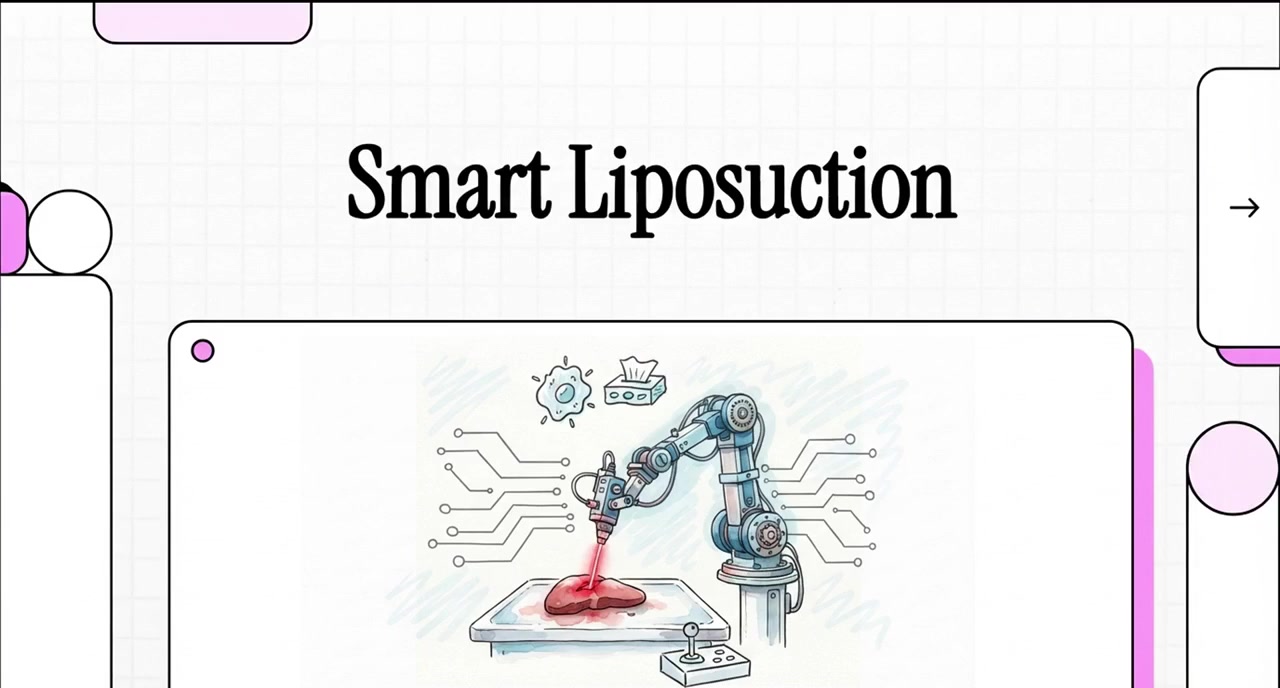
Three technologies get marketed together under one banner — three-dimensional planning, robotic assistance and intraoperative data — and the published evidence treats them very differently. Three-dimensional imaging is genuinely established: published cohorts use serial three-dimensional scans to measure volume change after surgery, and it is the method behind the objective retention figures in fat-grafting research. Intraoperative monitoring is documented too, in the form of temperature sensing, measured volumes and staged anaesthesia decisions, and it correlates with measurably lower complication rates in large registry analyses. Robotic cannula manipulation, by contrast, has no controlled liposuction literature at all. The most recent systematic review of robotic systems in plastic surgery screened 1,428 studies and included 31, of which the applications were microsurgery (16), breast reconstruction (8) and craniofacial or aesthetic surgery (7) — and none of them was a randomised trial of liposuction performed by a robot. If you have been weighing up body contouring after weight loss for a home around Sarasota, FL, this guide covers how it actually works, what it tends to cost, and where the results usually fall short.
The short version
- A 2025 systematic review screened 1,428 studies and found 31 on robotic plastic surgery, none a controlled liposuction trial.
- Three-dimensional imaging is described as an established measurement method, including a study tracking 40 patients with serial scans.
- A national registry of 69,424 patients found an overall complication rate of 1.16%, with one technique about 6.7 times riskier.
- Prophylaxis moved venous thromboembolism from 2.1% to 0.5% across 129,007 patients, with mortality up to 15% once it occurs.
- Devices reach market as Class II suction lipoplasty systems through the 510(k) route, which establishes equivalence rather than clinical benefit.
What three-dimensional planning actually changes
The useful purpose of three-dimensional imaging is measurement, not rendering. A published study of 40 patients used serial three-dimensional imaging with linear mixed-effects modelling to track volumetric and surface change after a procedure, which is the same method used to quote retention percentages in fat grafting. For a patient, that translates into three concrete uses.
First, it establishes a baseline against which the six-month result can be compared, which matters because swelling makes early photographs useless for judging contour. Second, it can quantify where the fat actually sits, which is how a surgeon separates deep fat that can be removed from superficial fat that determines definition. Third, it documents the pre-operative state in a way that a revision discussion can reference. None of that is a promise; a scan measures a starting point, and the operation still depends on the cannula and the judgement holding it.
| Technology | What the published literature shows | What it changes | What it does not change |
|---|---|---|---|
| Three-dimensional imaging and volumetric planning | Established measurement method in published cohorts (for example 40 patients tracked with serial three-dimensional scans) | Baseline documentation, retention measurement, revision reference points | It does not predict how your skin will conform to the new contour |
| Robotic or automated cannula guidance | No controlled liposuction trials; the 2025 systematic review of robotic plastic surgery found 31 studies, led by microsurgery and breast reconstruction | Case selection and ergonomics in specialised centres | No documented outcome advantage over experienced manual technique in liposuction |
| Intraoperative monitoring (temperature, volume, ultrasound) | Documented in technique descriptions; large registry analyses show lower complication rates when standard safety measures are applied | Ceilings on fluid and lidocaine, thermal safety, staged volume decisions | Monitoring does not improve aesthetics; it bounds risk |
| AI planning from three-dimensional body-mapping | Source material describes algorithms analysing fat distribution, skin elasticity and muscle tone to set the energy delivery parameters; no published aesthetic-liposuction trial of that design was located | Pre-operative parameter setting and case selection | Whether the plan changes the operation or only the picture of it |
| Post-operative recovery aids (lymphatic taping, drains, manual lymphatic drainage) | Fan-pattern lymphatic taping reported in a clinical trial to reduce abdominal bruising; manual lymphatic drainage for swelling; selective drain placement against seroma | Bruising and fluid collection, measured at follow-up | No trial shows a better final contour from any of them — they manage the recovery, not the aesthetic |
| Emerging tools from the source material (real-time fibre-optic temperature sensors, biofeedback systems, predictive recovery monitoring) | Described as emerging rather than established; no published aesthetic-liposuction validation | Intraoperative feedback and aftercare forecasting | Not yet evidence-based — treat as a roadmap, not a feature |
The data that does move outcomes
Where measurement has demonstrably changed liposuction, it is in risk rather than in beauty, and the numbers come from registries large enough to be worth quoting.
| Published analysis | Size | Finding | How a patient can use it |
|---|---|---|---|
| Technique-associated complication risk in a national registry cohort | 69,424 patients | Overall complication rate 1.16%; one technique carried roughly 6.7× the risk of another | Ask what technique is planned and what its published risk profile is |
| Venous thromboembolism prophylaxis analysis, ASJ Open Forum | 129,007 patients | Prophylaxis moved the VTE rate from 2.1% to 0.5%; VTE remains the complication most associated with mortality in cosmetic surgery, with published mortality from the event up to 15% | Ask what prophylaxis is used, on the day, by name |
| ASPS analysis of volume and safety | Large multi-site dataset | Overall complication rate 1.5%; 3.7% in patients above a body-weight threshold versus 1.1% below it; average volume removed around 2 litres | The plan should be sized to body weight, not to a volume target |
Read together, these three lines say something more useful than any device brochure. The dominant risks in liposuction are systemic — thromboembolism, fluid shifts, anaesthesia — and they are managed by protocol, staffing and discipline rather than by machine vision. A provider who can name the prophylaxis regimen, the anaesthesia provider's credentials and the facility's accreditation has demonstrated more relevant capability than one who advertises an algorithm.
When a clinic markets AI or robotics
The questions below are not hostile; they are the ones that separate a technology story from a clinical one, and any competent surgeon can answer them plainly.
The source material for this topic attaches specific improvements to the technology: roughly 15% more uniform extraction from instrumented motion, up to 40% less thermal injury where real-time sensing governs surface temperature, about 20% higher satisfaction where planning is AI-guided, and retention gains above 60% in enriched grafts using culture-expanded adipose-derived stem cells. Each is a claim about a population rather than about one patient, so the useful question at a consultation is which of them the surgeon measures in his own cases.
| Question to ask | Why it matters | An answer that should raise concern |
|---|---|---|
| Which part of my case does the technology change — planning, execution or aftercare? | Most clinical benefit from measurement is pre-operative and monitoring-based | A device name offered instead of a role description |
| What happens if the system fails or is unavailable during my case? | Published guidance assumes the surgeon's judgement drives the case, not the platform | No answer, or an implication that the case would be postponed |
| How many cases with this platform have you personally completed? | Experience is the variable the robotic literature cannot substitute for | Counts for the clinic rather than the surgeon |
| How is my imaging data stored, and for how long? | Identifiable clinical images are protected health information; storage and retention belong in the practice's privacy notice | Vague answers, or images shared without written consent |
| What is the total quoted cost with the technology included? | Platform time is billable operating-room time | A technology surcharge disclosed only at the consultation |
Where the credential data sits
The most reliable data in this niche is not in a device; it is in registries anyone can query. The American Board of Medical Specialties maintains certification records refreshed from its member boards, and the free Certification Matters lookup takes a surname, state and specialty; Florida publishes a practitioner profile for every licensed physician listing licence status, specialty certification, staff privileges, financial responsibility and any proceedings. Those two lookups, run before a consultation, answer the questions that matter most and cost nothing. Our five-step credential verification pass walks through both.
Three operational points close the loop. Volume limits and the aspirate-versus-fat distinction are handled in how much fat can be removed in one session, and the pooled complication figures per modality are collected in the published rates article. Where a clinic markets energy devices alongside robotics, the thermal limits that govern them are set out in our guide to thermal skin tightening, and the modality trade-offs in surgical versus non-surgical fat reduction. Cost, anaesthesia and facility components are itemised in the fee breakdown and checked against published ranges in the Sarasota cost guide. The technology questions themselves are in section six of the 50-question consultation checklist, which prints with the answers you still need.
What intraoperative data looks like in practice
The monitoring that has measurable value in liposuction is unglamorous and mostly numeric. Fluid management is a calculation, not an impression: published guidance describes infiltration of roughly three to four cubic centimetres of tumescent fluid per cubic centimetre of aspirate, with lidocaine capped at 35 mg/kg, and it warns that the total fluid given and removed has to be tracked as the case proceeds. Where energy devices are used, the relevant data is temperature — internal probe readings and a surface ceiling — because the therapeutic and the injurious temperatures sit close together. Where ultrasound-assisted techniques are used, the end-point is visible change in the tissue rather than a count of strokes. And the decision to stop, or to stage the remaining areas into a second operation, is itself a data decision based on volume removed, time elapsed and the patient's stability.
The distinction worth holding on to is that this monitoring bounds risk rather than improving beauty. A case that is stopped at the published volume and fluid limits is a case where the patient went home safely, which is a different kind of outcome from a case that produced a sharper contour. A consultation that discusses both — what the plan is and what the limits are — is doing what the data supports.
A data-driven aftercare plan, and the records behind it
Serial measurement is where planning technology pays off most clearly for the patient. A baseline scan or a standardised photographic set taken before the operation, repeated at six months when swelling has resolved, is what makes a revision conversation factual rather than a matter of memory and lighting. Ask what standard photographs or scans will be taken, at what intervals, and whether you will receive copies — and ask who stores them and for how long, since identifiable clinical images are protected health information and their handling belongs in the practice's privacy notice.
The aftercare itself follows the published pattern rather than any algorithm: compression garments for a defined number of weeks, bruising resolving over one to two weeks, swelling settling over months, and weight held stable through the window in which the final contour is being determined. The schedule is set out in our week-by-week recovery timeline and in the guide to compression garments and lymphatic massage, and the questions that make a surgeon commit to specifics are in section eight of the 50-question checklist.
One caution about the direction of the field. Devices are cleared by the FDA as Class II suction lipoplasty systems through the 510(k) route, which establishes substantial equivalence to a predicate device rather than a clinical benefit. That is why the marketing language moves faster than the evidence: a new platform can be legally marketed for adipose removal long before anyone publishes a cohort showing it does a better job than the technique it replaced. The reasonable position for a patient is not scepticism about technology but a demand for counts: how many cases, in whose hands, with what complication rate, measured how.
Frequently asked questions
Is robotic liposuction proven to beat an experienced surgeon's manual technique?
No. The article states that robotic cannula manipulation has no controlled liposuction literature, and a 2025 systematic review screened 1,428 studies and included 31 on robotic plastic surgery, led by microsurgery and breast reconstruction. None of them was a randomised trial of robot-performed liposuction.
What does three-dimensional imaging actually add to a liposuction plan?
It adds measurement rather than a better picture. A published study of 40 patients used serial three-dimensional scans with linear mixed-effects modelling to track volumetric change, giving a baseline for the six-month comparison, showing where the fat sits, and documenting the pre-operative state for any revision discussion.
Which numbers matter more than the device name at a consultation?
Registry figures. A national registry cohort of 69,424 patients found an overall complication rate of 1.16%, with one technique carrying roughly 6.7 times the risk of another, and a prophylaxis analysis of 129,007 patients moved the venous thromboembolism rate from 2.1% to 0.5%.
Sources
Published figures as of the access date (12 Sep 2026). Notebook basis: the notebook research set behind this pack supplied the technology framework (three-dimensional planning, robotic assistance, intraoperative data feedback, data security); every number below is checked against the published source listed with it.
1. Seth I, et al., Evaluating the Clinical Utility of Robotic Systems in Plastic and Reconstructive Surgery: A Systematic Review, Sensors 2025;25(10):3238 (1,428 studies screened; 31 included; microsurgery 16, breast reconstruction 8, craniofacial/aesthetic 7) — https://www.mdpi.com/1424-8220/25/10/3238
2. Three-Dimensional Morphometric Trajectories Following Lip Lift With or Without Fat Grafting, Aesthetic Surgery Journal Open Forum 2026 (40 patients; serial three-dimensional imaging with linear mixed-effects modelling) — https://pubmed.ncbi.nlm.nih.gov/42445689/
3. Saad M, et al., national registry analysis of liposuction complications, Aesthetic Surgery Journal 2025;45(12):1252–1262 (69,424 patients; 1.16%; 6.7×) — https://doi.org/10.1093/asj/sjaf147
4. ASJ Open Forum, venous thromboembolism prophylaxis analysis (129,007 patients; 2.1% to 0.5%; up to 15% mortality from the event) — https://academic.oup.com/asjopenforum/article/doi/10.1093/asjof/ojaf105/8241937
5. ASPS press release, How Much Liposuction Is ‘Safe’? The Answer Varies by Body Weight (1.5% overall; 3.7% versus 1.1%; average 2 L) — https://www.plasticsurgery.org/news/press-releases/how-much-liposuction-is-safe-the-answer-varies-by-body-weight
6. Comerci AJ, et al., Risks and Complications Rate in Liposuction: A Systematic Review, Aesthetic Surgery Journal 2024;44(7):NP454–NP463 — https://pubmed.ncbi.nlm.nih.gov/38563572/
7. ABMS, Verify Certification (primary-source certification records) — https://www.abms.org/board-certification/verify-certification/
8. Florida Department of Health, Practitioner Profile Search — https://mqa-internet.doh.state.fl.us/MQASearchServices/HealthCareProviders/PractitionerProfileSearch
9. US FDA device classification, suction lipoplasty system, 21 CFR 878.5040, Class II, 510(k) route, product code QPB — https://www.accessdata.fda.gov/scripts/cdrh/cfdocs/cfpcd/classification.cfm?ID=QPB
10. ASPS Practice Advisory on Liposuction: Executive Summary — https://www.plasticsurgery.org/documents/medical-professionals/health-policy/key-issues/executive-summary-on-liposuction.pdf
11. ISAPS Global Survey 2024 (more than 17.4 million surgical procedures recorded worldwide) — https://www.isaps.org/discover/about-isaps/global-statistics/global-survey-2024-full-report-and-press-releases/
Medical-safety note: the registry figures above describe populations and are not a prediction for any individual case, and no planning tool or assisted device replaces surgical judgement. Only a board-certified plastic surgeon who examines you can determine whether liposuction is appropriate for you.