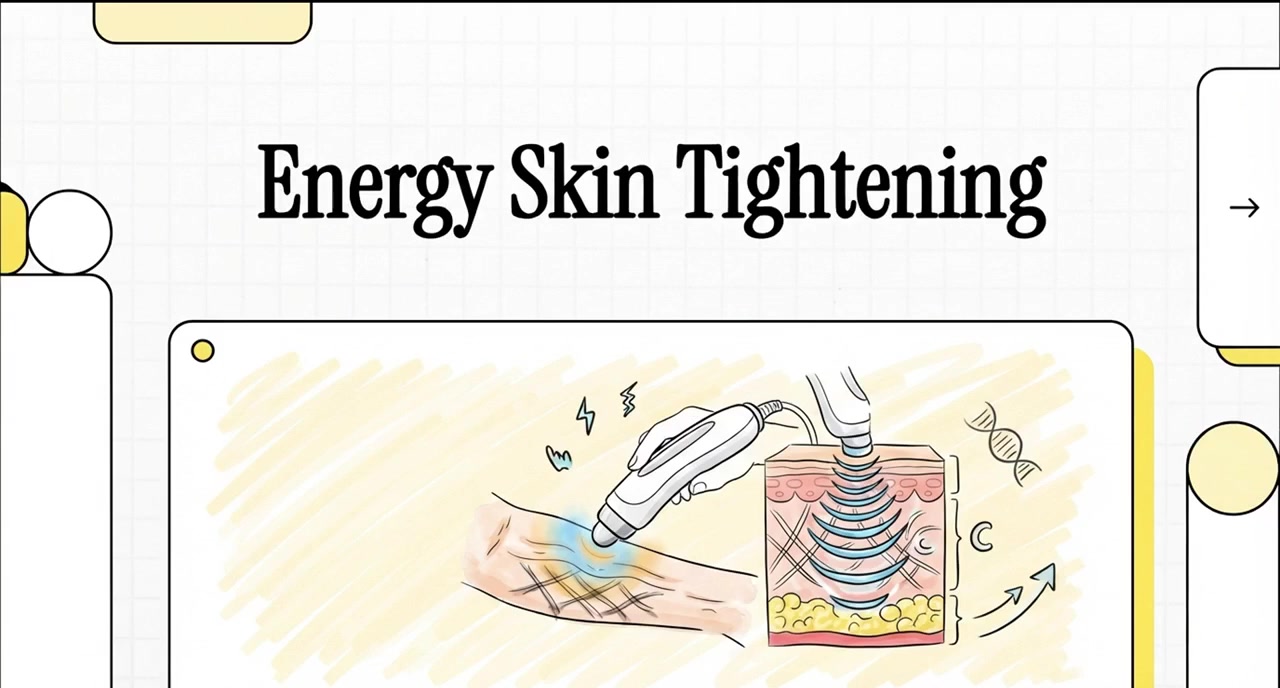
Tightening is a separate operation from fat removal, and the published numbers say so. Liposuction takes out subcutaneous fat; it does not change skin quality, and ASPS states plainly that liposuction cannot improve lax or inelastic skin. Energy-assisted tightening exists to close that gap, but it works inside a narrow thermal window: collagen needs to reach roughly 60 °C to 80 °C to contract, while the surface of the skin tolerates far less before it burns. Published work on radiofrequency body contouring found that immediate dermal contraction could not be achieved without a skin burn once the epidermal temperature passed 45 °C. Everything in this article is a consequence of that conflict. This is written for homeowners around Sarasota, FL who are looking into fat removal surgery and want the honest version rather than a sales page.
The short version
- The article states liposuction removes fat but cannot improve lax or inelastic skin, which tightening exists to address
- Collagen needs roughly 60 °C to 80 °C to contract while published work observed burns above a 45 °C epidermal temperature
- The measured cohort deposited 60 to 96 kJ per abdominal area, a mean of 72 kJ
- Technique descriptions allow the subdermal target 65 to 80 °C but never let the surface exceed 42 °C
- Published guidance treats the early months as uninformative, so the result should be judged at six months
Why the skin does not follow the fat
Subcutaneous fat is the scaffold the overlying skin drapes across. Remove a volume of it from an abdomen and the skin envelope stays the same size, so the contour that emerges depends entirely on how much elasticity the skin still has. The variables that predict how well it recovers are documented well enough to assess at a consultation: age, genetically determined collagen and elastin quality, sun exposure accumulated over decades in Florida, the number of pregnancies, how much weight the patient has lost and how fast, and how many times the area has been operated on before.
A surgeon can test elasticity directly rather than asking about it. A pinch test measures how much skin can be lifted and how quickly it retracts; a recoil assessment at the flank and the lower abdomen gives a working picture of the same property the energy device is trying to restore mechanically. Where elasticity is poor, published guidance points to excision — an abdominoplasty or a body lift — because no amount of deep heat will contract an envelope that has lost its recoil. The distinction between fat removal and skin removal is covered in more detail in our comparison of liposuction against a tummy tuck and body contouring.
The thermal window, in published figures
Radiofrequency and helium-plasma devices heat tissue through its own electrical resistance, so the temperature achieved depends on the tissue's water content and on how long the energy is applied. Peer-reviewed measurements in body contouring work give a usable frame for what those temperatures mean.
| Thermal marker | Published value | What it means at a consultation |
|---|---|---|
| Collagen shrinkage temperature | 60–80 °C across collagen types | The target range where contraction occurs. Below it, nothing tightens. |
| Epidermal burn threshold | Burns observed once epidermal temperature passed 45 °C in an RF body-contouring study | The narrow point of the procedure: the surface cannot be allowed to reach the temperature the dermis needs. |
| Energy typically deposited | 60–96 kJ per abdominal area (mean 72 kJ) in the same study | Ask what energy has to be deposited to produce a measurable contraction — and how it is monitored. |
| Aspirate in the measured cohort | 0.5–3.4 L (mean 2.0 L); BMI 20.8–31.7 | The contraction data comes from moderate-volume body contouring, not large-volume debulking. |
Two consequences follow. First, the temperature that produces contraction is reached in the fat and the septal connective tissue that encases it, not in the dermis — the study that measured this found the strongest contraction response in adipose tissue containing septal connective tissue and reticular collagen fibres, and the highest contraction threshold in the dermis itself. Second, the effect is partly immediate and partly biological: heat causes an immediate shortening of collagen, and the injury response that follows lays down new collagen over the following weeks and months, which is why the contour keeps changing after the swelling resolves.
Which energy approach, and how strong the evidence is
Three families appear in published practice: subdermal radiofrequency delivered on an internal probe after fat removal, helium-plasma radiofrequency, and fractional radiofrequency microneedling or surface laser applied to texture rather than to bulk. They differ in where the heat is deposited and in what the published base can actually support.
| Approach | Where heat goes | Strength of the published base | Main documented risk |
|---|---|---|---|
| Subdermal radiofrequency on an internal probe | Dermis and subdermal plane from below; surface spared | Contraction measured directly, in a small number of cohorts | Serrations, local burns, fluid collections |
| Helium-plasma radiofrequency | Very high local temperature at the probe tip | Case-series heavy; a 2025 systematic review assessed the published series without controlled comparisons | Internal thermal injury with a misleading presentation |
| Fractional radiofrequency microneedling or surface laser | Dermis, from the surface | Better studied for texture and facial tightening than for large body areas | Post-inflammatory pigment change, blistering |
| Named platforms in current use | BodyTite (bipolar radiofrequency), Renuvion J-Plasma (helium plasma plus radiofrequency), Morpheus8 (fractional radiofrequency microneedling) and Quantum RF; diode lasers sit alongside radiofrequency and helium plasma as the energy families | Compared in the notebook material by delivery mechanism rather than by head-to-head outcome trials | Operator technique remains the dominant variable, not the platform name |
The thermal-injury case that matters most in the literature is instructive because of how it presented rather than because it was common: a 37-year-old woman returned five days after a liposculpture procedure with fevers, erythema and pain that worsened on antibiotics, with imaging showing subcutaneous emphysema in the abdominal wall; the eventual diagnosis was internal thermal injury, treated with multiple debridements. The lesson for a consultation is not that these devices are unsafe in trained hands — it is that a complication from delivered energy can look like an infection, so the patient needs to know which symptoms to report and to whom.
Monitoring is the whole safety argument
Because the therapeutic and the injurious temperatures sit close together, published technique descriptions rely on measurement rather than judgement. Internal probes use thermistors at the tip, with reported subdermal target readings in the 55 °C to 65 °C range; surface monitoring uses either contact thermometry or infrared thermography to keep the skin below its burn threshold, and hand-pieces are designed to cut energy when a preset ceiling is reached. Ask directly what the ceiling is, how it is measured, who watches it during the case, and what happens to the treatment plan if the area will not accept enough energy to contract.
The two numbers that bracket safety are stated plainly in the source material: the subdermal target runs 65–80 °C, and the cutaneous surface is never allowed above 42 °C — the ceiling continuous infrared monitoring exists to enforce. The same material sets the room conditions that keep that margin: ambient temperature 20–23 °C, relative humidity 30–60%, and more than 20 positive-pressure air exchanges an hour. The collagen change at that temperature is described as hyalinisation.
One structural point is worth understanding before any of this. Radiofrequency, laser and ultrasound lipolysis devices, like the suction lipoplasty systems they accompany, are cleared by the FDA through the 510(k) route as Class II devices — product code QPB covers a suction lipoplasty system intended to remove adipose tissue for aesthetic body contouring. That clearance speaks to the device being substantially equivalent to a predicate, not to a promised degree of tightening in your abdomen. The behavioural difference between a measured consultation and a sales consultation is usually the willingness to quote a range rather than a result.
Who is actually a candidate
Published selection criteria for energy-assisted tightening are consistent and unglamorous, and they exclude most of the people the marketing reaches.
| Factor | Favourable | Where tightening alone underdelivers |
|---|---|---|
| Skin elasticity (pinch and recoil) | Good recoil, minimal laxity | Loose, inelastic skin over the same area |
| Weight stability | Stable for 6–12 months | Recent large loss, or GLP-1 dose still escalating |
| BMI and area | Moderate-volume contouring of a discrete area | Circumferential laxity after major weight loss |
| Expectation | Contour improvement measured in centimetres | Any expectation of excision-grade tightening |
The honest framing is that energy-assisted tightening improves contour where skin still has recoil, and it is a supplement to fat removal rather than a substitute for a lift. If the pinch test says the envelope is finished, the published answer is excision, and the question to ask is who performs it and where. Where the answer involves a full lift, the recovery and compression schedule belongs in the same conversation, and our week-by-week recovery timeline and the guide to compression garments and lymphatic massage cover what those weeks require.
Two practical screens come before any of this. First, credential and facility checks — the five-step verification pass takes minutes and should be finished before a tightening plan is discussed at all. Second, the fee structure: energy-assisted work adds device time and can add an anaesthesia hour, so ask for the itemised quote and check it against the components in our fee breakdown rather than against a single advertised price. The 50-question consultation checklist carries the thermal-safety questions in section four, ready to print.
What the result looks like at three, six and twelve months
Swelling from both the liposuction and the thermal injury hides the contour for the first six weeks, which is why published guidance treats the early months as uninformative about the final shape. Collagen remodelling continues for months afterwards, and the measurable contraction in the published cohorts was reported against linear measurements taken after that settling period rather than immediately post-operatively. The practical rule: judge the result at six months, not at six weeks, and keep weight stable through that window because a 5 kg regain redistributes fat into exactly the areas the energy was used on. Skin tightening is not permanent against weight regain, and no device changes that.
Frequently asked questions
Why can't energy devices simply use more heat to tighten skin?
Because collagen needs roughly 60 °C to 80 °C to contract while the skin surface tolerates far less. Published radiofrequency body-contouring work observed burns once epidermal temperature passed 45 °C, so the surface cannot be taken to the temperature the deeper tissue needs.
What surface temperature limit applies during energy-assisted skin tightening?
Published technique descriptions state the cutaneous surface is never allowed above 42 °C while the subdermal target runs 65 to 80 °C. Continuous infrared monitoring exists to enforce that surface ceiling, and hand-pieces are designed to cut energy when a preset limit is reached.
When should the result of skin tightening be judged?
At six months, not six weeks. Swelling from both the liposuction and the thermal injury hides the contour for the first six weeks, and collagen remodelling continues for months afterwards, so published guidance treats the early months as uninformative about the final shape.
Sources
Published figures as of the access date (12 Sep 2026). Notebook basis: the notebook research set behind this pack supplied the questions and the modality framework (thermal safety, energy-assisted tightening, candidacy); every number below is checked against the published source listed with it.
1. Collagen contraction and thermal thresholds in radiofrequency body contouring, peer-reviewed study (60–80 °C shrinkage range; dermal contraction impossible without burn above 45 °C epidermal temperature; 60–96 kJ per abdominal area; aspirate 0.5–3.4 L) — https://pmc.ncbi.nlm.nih.gov/articles/PMC3036829/
2. Daulat et al., Feel the Burn: Case Report of Internal Thermal Injury from Liposculpture, Am J Case Rep 2023 (presentation, imaging, debridement) — https://pmc.ncbi.nlm.nih.gov/articles/PMC10071549/
3. Swanson E., A Systematic Review of Helium Plasma Radiofrequency, Annals of Plastic Surgery 2025;95(6):711–735 — https://pubmed.ncbi.nlm.nih.gov/40768710/
3b. Helium Plasma Radiofrequency for Aesthetic Subdermal Treatment: A Systematic Review and Meta-Analysis, Aesthetic Surgery Journal Open Forum 2026 — https://pubmed.ncbi.nlm.nih.gov/42358657/
4. Radiofrequency review of the literature, Turkish Journal of Plastic Surgery (subdermal probe thermistor targets reported at 55–65 °C) — https://www.ovid.com/jnls/tjps/fulltext/10.4103/tjps.tjps_65_18~radiofrequency-review-of-literature
5. ASPS, Liposuction Results (lax skin tone cannot be improved by liposuction) — https://www.plasticsurgery.org/cosmetic-procedures/liposuction/results
6. ASPS Practice Advisory on Liposuction: Executive Summary (facility criteria, anaesthesia responsibility, serial procedures) — https://www.plasticsurgery.org/documents/medical-professionals/health-policy/key-issues/executive-summary-on-liposuction.pdf
7. US FDA device classification, suction lipoplasty system, 21 CFR 878.5040, Class II, product code QPB — https://www.accessdata.fda.gov/scripts/cdrh/cfdocs/cfpcd/classification.cfm?ID=QPB
8. ISAPS Global Survey 2024 (liposuction remains among the most performed surgical procedures worldwide) — https://www.isaps.org/discover/about-isaps/global-statistics/global-survey-2024-full-report-and-press-releases/
Medical-safety note: the temperatures, thresholds and device classes above are published figures and regulatory facts, not a recommendation about any provider or any person. Only a board-certified plastic surgeon who examines you can determine whether liposuction or any form of skin tightening is appropriate for you, and no procedure can guarantee a result.