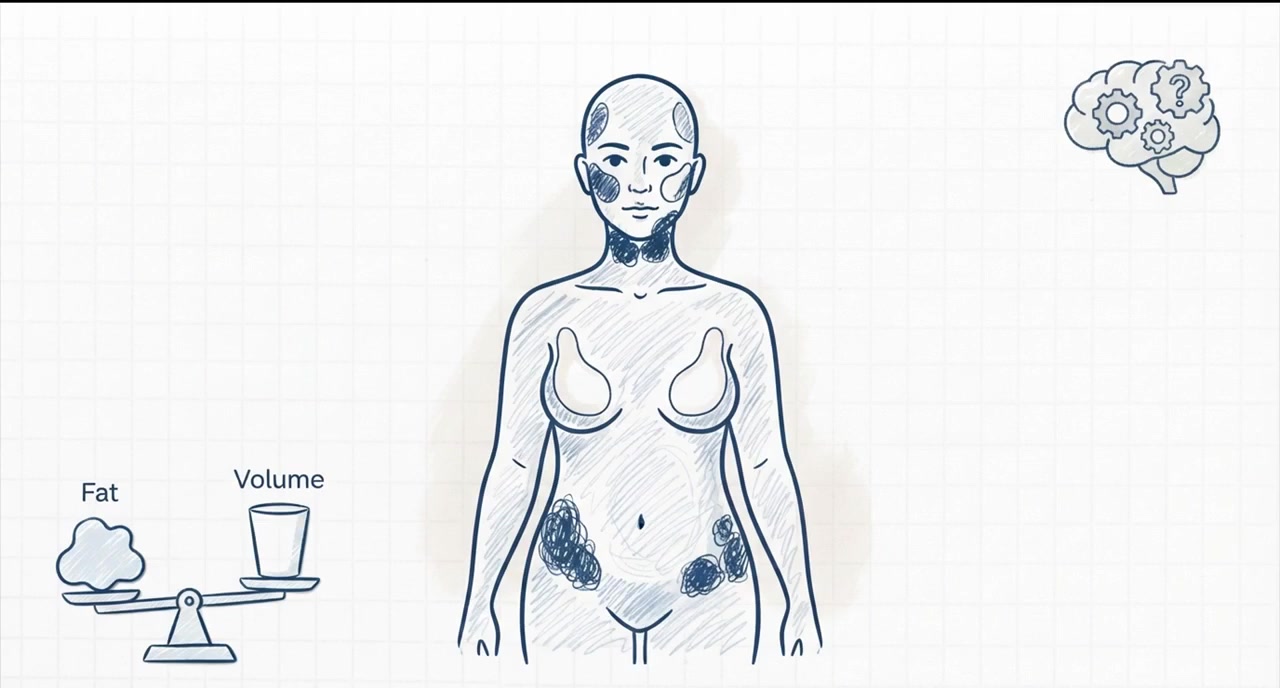
Medication-driven weight loss moves the number on the scale without deciding where the fat comes off, and that is the entire clinical problem. In the STEP 1 trial, 2.4 mg weekly semaglutide produced a mean weight change of −14.9% at 68 weeks against −2.4% with placebo; in SURMOUNT 1, tirzepatide produced −15.0%, −19.5% and −20.9% at 72 weeks across the 5 mg, 10 mg and 15 mg arms against −3.1% with placebo. Those are large, well-documented losses delivered by a drug that has no opinion about which depot it takes them from. The result is a specific and now very common presentation: a patient at goal weight with stubborn residual fat in the abdomen, flank, arms or under the chin, plus volume loss in the face and breasts where it was wanted, plus skin that has lost some of its recoil. If you have been weighing up body contouring after weight loss for a home around Sarasota, FL, this guide covers how it actually works, what it tends to cost, and where the results usually fall short.
The short version
- Published trial data measured fat mass and lean mass falling together, so volume disappears from the face while deposits persist elsewhere.
- In the STEP 1 trial, 2.4 mg weekly semaglutide produced a mean weight change of minus 14.9 percent at 68 weeks.
- SURMOUNT 1 reported tirzepatide weight changes reaching 20.9 percent at 72 weeks against 3.1 percent with placebo.
- A propensity-matched comparison found long-term GLP-1 users needed breast-focused procedures far more often, 56.9 percent against 21.7 percent.
- Post-weight-loss contouring divides on skin rather than fat, and ASPS states that liposuction cannot improve lax or inelastic skin.
What the medication did to the numbers, and what it left behind
The published trial data is worth reading for the composition detail rather than the headline percentage.
| Published trial | Patients | Weight outcome | Why it matters before surgery |
|---|---|---|---|
| Semaglutide 2.4 mg weekly versus placebo, 68 weeks | 1,961 | −14.9% versus −2.4% (treatment difference −12.4 percentage points) | A 15% loss can resolve enough of the fat to expose laxity that was hidden before. |
| Body-composition substudy of the same trial (DEXA) | 140 | Weight change −15.0% versus −3.6%; total fat mass and lean mass both measured by DEXA | Loss is not selective: lean tissue moves as well as fat, which is one reason the result looks different from the expectation. |
| Tirzepatide 5, 10 and 15 mg versus placebo, 72 weeks | 2,539 | −15.0%, −19.5% and −20.9% versus −3.1% | A 20% loss approaches the territory where abdominal skin envelopes no longer match the new underlying volume. |
Two consequences follow for anyone considering contouring. First, the drug does not distinguish between subcutaneous fat that is removable and visceral fat that is not — liposuction operates on the layer above the muscle, and a patient whose remaining bulk is intra-abdominal will not get the result they picture. Second, volume loss in the face and breasts is common and is not something liposuction corrects; it is corrected, where the patient wants it corrected, with fat transfer or an implant decision that belongs in a separate conversation. The distinction between the treatable layer and the rest is set out in how much fat can be removed in one session.
What the surgical literature now shows for this population
The published body-contouring literature has caught up with the medication era in the last two years, and the findings are more specific than expected.
| Published cohort | Size | Finding | Question to ask |
|---|---|---|---|
| Post-weight-loss body contouring by weight-loss modality, single centre, 2019–2024 | 1,002 | Modality mix: surgery 67.9%, lifestyle 14.3%, GLP-1 pharmacotherapy 7.8%, combination 10.1%; complications compared across groups at 90 days | What is your own complication rate for my procedure in patients who lost weight the way I did? |
| Propensity-matched comparison of body contouring after bariatric surgery versus long-term GLP-1 therapy | Population database, matched | GLP-1 users more often needed breast-focused procedures (56.9% versus 21.7%, OR 4.77); reduced intraoperative bleeding observed in the GLP-1 group | Has the plan accounted for the procedure mix this population actually needs? |
| Trends in weight-loss modality among body-contouring patients, 2012–2024 | 27,443 | Bariatric surgery was the most prevalent single modality at 15.86%; abdominal contouring predominated over extremity contouring after larger losses | Which area does the laxity actually sit in — and is one operation or two planned? |
The second row is the one patients rarely hear. In a propensity-matched database comparison, patients whose weight loss came from long-term GLP-1 therapy were substantially more likely to need breast-focused procedures than post-bariatric patients — roughly 57% against 22% — which is consistent with the pattern of volume depletion in the upper body rather than with anything intrinsic to the medication. If a surgeon's plan for a post-GLP-1 patient addresses only the abdomen, that is a plan built for the bariatric population.
Liposuction, a lift, or both
Post-weight-loss contouring divides on skin, not on fat. Where the skin envelope still has recoil, removing the residual fat deposits is enough and the operation is liposuction. Where the envelope has lost its recoil, removing fat from under lax skin makes the laxity more visible, and the published answer is excision. ASPS states that liposuction cannot improve lax or inelastic skin, and the tummy-tuck literature is explicit that the operation addresses skin and fascial laxity rather than weight. Where laxity runs around the trunk rather than sitting on the front, the plan may be a 360° or extended tummy tuck, which addresses the abdomen, lower back, waistline and hips in one operation.
| Option | Addresses | Published context | Typical recovery shape |
|---|---|---|---|
| Liposuction of residual deposits | Stubborn fat in flanks, back, arms, under the chin | Complication rates are documented per modality, with seroma and contour irregularity the usual local issues | Desk work within days to two weeks; compression several weeks |
| Excision with a lift (for example abdominoplasty, arm lift, thigh lift) | Redundant skin, and fascial laxity where present | Local complications are considerably more common than systemic ones: roughly 10–20% local versus under 1% systemic across published abdominoplasty series, with seroma the most frequent | Longer: drains possible, weeks of restricted activity |
| Staged combination | Excision plus contouring, often in two operations | Published safety guidance favours serial procedures over one very long case when total volume would otherwise be high | Two recovery periods, planned months apart |
| Circumferential (360°) tummy tuck | Loose skin and residual fat across the abdomen, lower back, waistline and hips at once | An extended incision addresses all four regions in one operation instead of treating them separately | A scar that runs around the torso; a longer single recovery |
The comparison in full — including what each operation does to the abdominal wall and what each costs — is in liposuction versus a tummy tuck versus body contouring. Patients who would like to avoid an operation altogether should weigh what non-surgical fat reduction can and cannot deliver in the non-surgical comparison; the published ceiling on cryolipolysis is well below what a lift achieves.
Sequencing, and the questions that decide it
The timing conversation is where most of the risk in this population is managed, and it has four parts. Weight should be stable before the operation — a goal weight reached last month is a moving target, and contouring performed on a falling weight is contoured again by the next 5 kg. The BMI threshold for outpatient safety should be stated as a number, not implied. Medication status matters twice: continued GLP-1 therapy can slow gastric emptying, which is relevant to anaesthesia, and some surgeons ask patients to hold the drug for a defined interval with the prescribing physician's agreement; that decision belongs to the surgeon and the prescriber together, not to a website. And nutritional status after a rapid 15–20% loss deserves a look, because wound healing is a protein-dependent process. Layering subdermal energy under the skin — Renuvion J-Plasma, BodyTite or the AYON system — is the published method for contracting tissue as the fat comes off, and it is the technical expression of the shift toward preservation: restoring natural anatomy rather than creating an over-operated appearance.
Then there is the question of what the operation is for. Contouring after weight loss is usually not about a number on a scale; it is about clothing fit, comfort, and how the body reads in a mirror. That makes the pre-operative conversation concrete: name the areas, name the garments, and ask how many patients with your starting point the surgeon has taken to that endpoint. Ask about revision policy in writing, because the two most common local complications — seroma and contour irregularity — are managed, not prevented, and a revision is occasionally part of that management.
Finally, the financial shape of the decision: medication-era contouring often runs to more than one area, and quoting a single area is where estimates go wrong. The itemised components are set out in the fee breakdown, the published ranges are collected in the Sarasota cost guide and the wider provider cost guide, and the questions that surface hidden charges sit in section seven of the 50-question checklist. Before any of it, the credential verification pass should be complete, and the likely recovery shape is in the week-by-week timeline and the compression and lymphatic care guide.
The measurements worth taking before the operation
Four numbers belong in the pre-operative record because each one changes the plan. Body mass index sets candidacy: published large-volume and high-definition series commonly use an upper limit around 30 for the technique they describe, while the 615-patient cohort with the lowest complication rates excluded anyone above 30, anyone smoking, and anyone with major comorbidity. Weight stability sets timing: a figure held for six to twelve months behaves predictably under a cannula, and a figure still falling after a recent dose escalation does not. A skin pinch test at the abdomen, flank and arm sets whether the operation is contouring or excision — the difference between a two-week recovery and a two-month one. And an aspirate estimate sets both the anaesthesia decision and the safety margin, because published guidance treats the total volume removed as a planning variable rather than a target to be pushed.
The fifth number is not a measurement at all: it is the number of areas. Post-GLP-1 patients present with a distribution, not a spot, and each additional area adds operative time, garment changes and money. Ask for the plan area by area with the cost attached to each, then ask which of those areas would look acceptable left alone. Some of them usually would be, and a surgeon who says so is the one to keep talking to.
Frequently asked questions
Why do I still have stubborn fat after losing weight on a GLP-1 medication?
Medication-driven weight loss is not selective. Published trial data measured fat mass and lean mass falling together, so volume disappears from the face and breasts while deposits persist in the abdomen and flanks. The drug also does not distinguish subcutaneous fat that can be removed from visceral fat that cannot.
What does the trial data show about how medication-driven weight loss comes off?
The loss is not selective. In the STEP 1 trial, 2.4 mg weekly semaglutide produced a mean weight change of −14.9% at 68 weeks versus −2.4% with placebo, and a body-composition substudy of 140 patients measured fat mass and lean mass falling together.
Do GLP-1 patients need different body contouring than post-bariatric patients?
A propensity-matched database comparison found that patients whose weight loss came from long-term GLP-1 therapy were more likely to need breast-focused procedures, 56.9% versus 21.7%, an odds ratio of 4.77. A plan that addresses only the abdomen is built for the bariatric population.
Sources
Published figures as of the access date (12 Sep 2026). Notebook basis: the notebook research set behind this pack supplied the post-weight-loss framework (volume depletion, laxity after rapid loss, 360 approaches, sequencing, preservation rather than removal alone); every number below is checked against the published source listed with it.
1. Wilding JPH, et al., Once-Weekly Semaglutide in Adults with Overweight or Obesity (STEP 1), N Engl J Med 2021 (−14.9% versus −2.4% at 68 weeks; n = 1,961) — https://pubmed.ncbi.nlm.nih.gov/33567185/
2. Impact of Semaglutide on Body Composition in Adults With Overweight or Obesity: Exploratory Analysis of the STEP 1 Trial (DEXA substudy; n = 140; −15.0% versus −3.6%) — https://pmc.ncbi.nlm.nih.gov/articles/PMC8089287/
3. Jastreboff AM, et al., Tirzepatide Once Weekly for the Treatment of Obesity (SURMOUNT 1), N Engl J Med 2022 (−15.0%, −19.5%, −20.9% versus −3.1% at 72 weeks; n = 2,539) — https://pubmed.ncbi.nlm.nih.gov/35658024/
4. Post Weight Loss Body Contouring Surgery: Complication Rates Following Bariatric Surgery, Injectable GLP-1 Receptor Agonist Pharmacotherapy and Lifestyle, Aesthetic Surgery Journal 2026 (1,002 patients; 90-day outcomes by modality) — https://pubmed.ncbi.nlm.nih.gov/41742366/
5. Outcomes of Body Contouring Surgery After Bariatric Surgery vs GLP-1 Receptor Agonist-Induced Weight Loss: A Propensity Score Matched Analysis, Aesthetic Plastic Surgery 2026 (breast-focused procedures 56.9% versus 21.7%, OR 4.772) — https://pubmed.ncbi.nlm.nih.gov/41991800/
6. Trends in preoperative weight loss modalities among patients receiving body contouring surgery, Surgery for Obesity and Related Diseases 2026 (27,443 patients; bariatric surgery 15.86%) — https://pubmed.ncbi.nlm.nih.gov/42686475/
7. Systematic review of complications after abdominoplasty (approximately 10–20% local, under 1% systemic; seroma 15.4% in a 1,008-case series) — https://pmc.ncbi.nlm.nih.gov/articles/PMC5621815/
8. ASPS, Liposuction Results (lax skin tone cannot be improved by liposuction) — https://www.plasticsurgery.org/cosmetic-procedures/liposuction/results
9. ASPS, Who is a good candidate for liposuction? — https://www.plasticsurgery.org/cosmetic-procedures/liposuction/candidates
10. ASPS Practice Advisory on Liposuction: Executive Summary (serial procedures, fluid management, facility criteria) — https://www.plasticsurgery.org/documents/medical-professionals/health-policy/key-issues/executive-summary-on-liposuction.pdf
11. ISAPS Global Survey 2024 (procedures worldwide, including non-surgical skin tightening in the top five) — https://www.isaps.org/discover/about-isaps/global-statistics/global-survey-2024-full-report-and-press-releases/
Medical-safety note: trial percentages describe averaged outcomes in study populations and are not predictions for any individual, and nothing here is advice about starting, continuing or pausing a prescription medication. Only a board-certified plastic surgeon who examines you can determine whether body contouring is appropriate for you, and your prescribing clinician should be part of any decision about medication timing around surgery.