Abdominal etching is two operations in one: a deep debulking that removes bulk, and a controlled superficial pass that thins the fat overlying the muscle so the natural grooves read as shadows. That second pass is what creates definition, and it is also where the published risk sits, because the tissue being thinned is a few millimetres from the skin. The evidence base is small and recent enough to read in an afternoon: the largest published cohorts are in the low hundreds of patients, one 743-patient series found that the most aggressively etched group had the lowest durable satisfaction, and a 976-person preference study rated lightly defined abdomens as more attractive than heavily etched ones. This article sets out what the technique involves, what the published numbers actually show, and how to tell whether a clinic is selling definition or delivering it. The technique is credited to Hoyos and Millard, whose published work established high-definition liposuction as a controlled procedure rather than a marketing term for aggressive suction. Most homeowners who read this are comparing female liposuction options around Sarasota, FL, so what follows sticks to the details that change in practice.
GLP-1 Era Body Contouring - published guidance, explained without the sales pitch.
The short version
- Abdominal etching is two operations in one: deep debulking removes bulk, then a controlled superficial pass thins fat along muscle margins.
- A 743-patient series found the most aggressively etched era scored lowest on durable satisfaction, with fake abs reports clustering there.
- A crowdsourced study of 976 respondents rated the lightest abdominal contour most attractive, at 6.0 against 5.0 and 4.0.
- A 615-patient cohort combining ultrasound with Scarpa fascia preservation reported 0.49 percent seroma, 0.32 percent haematoma and 0.16 percent infection.
- Seroma is the complication to expect, reported as the most common in a 62-patient classification series of abdominal etching.
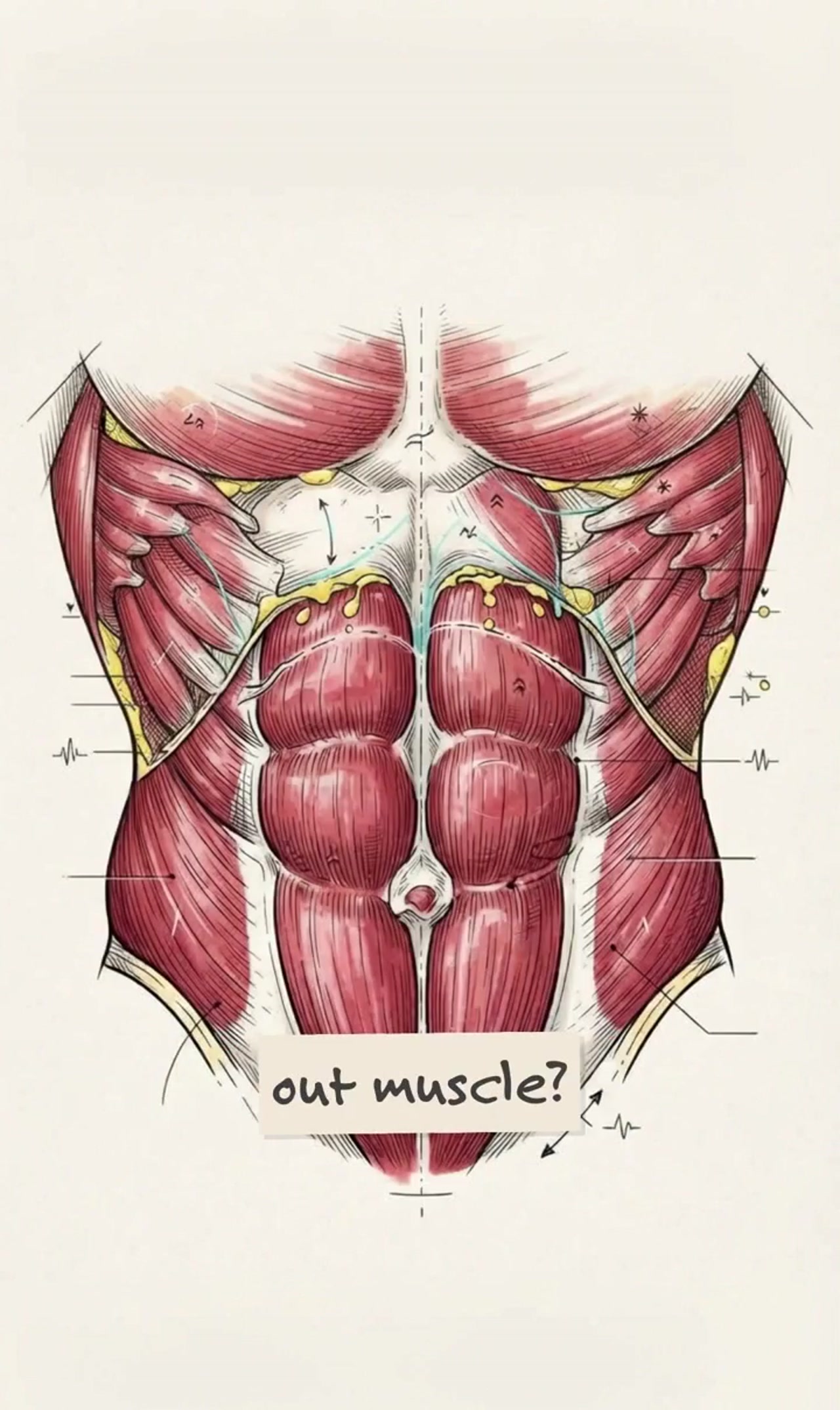
The anatomy the technique depends on
Abdominal fat is layered, and the layers behave differently under a cannula. Deep fat sits beneath the Scarpa fascia and can be removed in volume with relatively little risk to the surface contour. Superficial fat sits between the Scarpa fascia and the dermis, in a layer whose thickness varies by region and by patient, and it is this layer that determines whether muscle shows. Etching deliberately thins the superficial layer along the natural lines of the rectus abdominis, the linea alba and the obliques, leaving slightly thicker columns of fat where the muscle bellies sit so light falls on ridges rather than a flat plane.
Two structural details shape the published technique descriptions. First, the Scarpa fascia is treated as a boundary worth preserving in the small-incision approaches: a 615-patient cohort that combined ultrasound with Scarpa fascia preservation reported mean BMI 24.6 and mean aspirate of 3.4 L with three seromas (0.49%), two haematomas (0.32%) and one infection (0.16%). Second, the fat distribution is what permits the effect at all — a patient with a thick superficial layer and low muscle definition has the most to work with, which is why exercise history and body composition appear in every published selection discussion.
| Layer | What the surgeon does | Effect on the result | Main risk when overdone |
|---|---|---|---|
| Deep fat (below the Scarpa fascia) | Volume removal with larger cannulas | Reduces waist and flank thickness | Over-thinning leaves a hollow, uneven plane |
| Superficial fat (above the Scarpa fascia) | Controlled thinning along muscle margins only | Creates the grooves that read as definition | Surface irregularity, contour depressions, adhesion |
| Skin and subcutaneous envelope | Not removed; compressed afterwards | Determines whether etched lines sit smooth or bunch | Laxity after healing, visible skin rippling |
Protection during the case is procedural rather than technological. Tumescent infiltration is used to reduce bleeding and to increase the distance between the cannula and the skin; the published advisory describes infiltration of roughly 3–4 cc of fluid per cc of aspirate, with lidocaine doses capped at 35 mg/kg and serial procedures preferred over one long case where volume would otherwise be large. Ultrasound-assisted devices emulsify fat, which allows it to be aspirated with less mechanical force; the trade-off is added energy and time, and the published reviews that compare modalities find the added benefit is modest rather than transformative. Device families differ in how the fat is prepared: ultrasound-assisted liposuction (VASER) emulsifies fat with ultrasonic sound waves before it is aspirated, while power-assisted liposuction (PAL) uses rapid mechanical cannula vibration to lower the effort and the tissue trauma of each pass. Ports are placed for the areas being shaped — anterior abdomen, flanks and pectorals — so that fine cannulas reach each groove, and the total aspirate volume stays a limit to be respected rather than a target. Where a case runs long or aspirate volumes are large, published safety guidance adds thromboembolism prophylaxis: low-molecular-weight heparin and compression stockings.
What the published series show
Definition is the one part of liposuction where the literature is unusually direct about the trade-off. Three cohorts are worth knowing.
| Published series | Patients | Key figures | What it changes for a patient |
|---|---|---|---|
| Male ultrasound-assisted contouring, grouped by era (conventional 2008–2011, definition 2011–2014, natural 2015–2019, natural with energy tightening 2019–2024) | 743 | Mean satisfaction 59.3 → 57.7 → 66.8 → 73.8; the heavily etched era scored lowest on durable satisfaction despite high early ratings; self-reported “fake abs” clustered there; the best outcomes were in patients with BMI ≤25 exercising at least four times a week | Aggressive etching buys early drama and pays for it later. Ask what the plan looks like at two years, not two months. |
| Classification series, single surgeon, 2016–2022 | 62 (42 men) | Mean age 36; four body-habitus classes; seroma was the most common complication; long-lasting results and high satisfaction reported by the authors | Seroma, not infection, is the complication to expect. Ask about drain policy and how fluid collections are managed. |
| Segmental ultrasound-assisted liposuction with Scarpa fascia preservation, 2021–2024 | 615 | Mean BMI 24.6; mean aspirate 3.4 L; 0.49% seroma, 0.32% haematoma, 0.16% infection | Complication rates in the published low range depend on an exclusion list: no smoking, BMI under 30, no major comorbidity. |
Read together, the three series say something a marketing page will not. The technique is safe in selected patients and reproducible in experienced hands, but its satisfaction curve is not linear in how much definition was carved. The 743-patient analysis is the clearest evidence available that more etching is not better etching: the era with the most aggressive sculpting produced the lowest durable patient-reported scores, and the improvement across eras came from moving toward natural transitions, with energy tightening as a selective adjunct rather than a routine one.
What patients expect versus what a preference study found
The definition a patient asks for and the definition a general audience finds attractive are not the same thing. A crowdsourced study of 976 respondents rated three degrees of female abdominal contouring and found the lightest contour scored highest (median attractiveness 6.0) ahead of moderate (5.0) and heavy etching (4.0). The practical use of that finding is at the consultation itself: bring photographs you like and photographs you don't, and ask the surgeon which category those images fall into and how many patients they have taken from your starting point to that endpoint.
| Factor | Predicts a good etched result | Predicts disappointment |
|---|---|---|
| Starting fat thickness (superficial layer) | Enough fat over the muscle to shape | Already lean; nothing to thin without hollowing |
| Body mass index and training history | BMI 25 or below, training at least 4x weekly, stable weight | Weight trending down, or BMI rising |
| Skin quality | Good elastic recoil on a pinch test | Laxity, striae, previous abdominal surgery |
| Acceptance of revision risk | Willing to accept a defined chance of a touch-up, in writing | Expects a single-session guarantee |
| Weight stability over the long term | Stable weight; published series describe definition holding past five years | Regain, which blunts definition faster than it returns volume |
Healing into the grooves
The etched lines only read as definition once the superficial spaces have healed flat against the muscle, which is why aftercare is not optional. Compression holds the skin against the underlying plane while the space closes; the published guidance for liposuction recovery uses four to six weeks of garment wear, with bruising typically resolving in seven to ten days and swelling taking months. Manual lymphatic drainage is used to move serous fluid and limit the persistence of swelling, and the evidence for it is promising rather than conclusive — one prospective comparison in abdominoplasty with liposuction measured 9.8 cm versus 6.6 cm of improvement with drainage, but did not reach statistical significance. What the healed result cannot tolerate is fluid pooling, so the drain decision and the massage schedule belong in the same conversation.
Two operational questions decide more than technique does. The first is who performs the case and where the facility stands on accreditation and anaesthesia cover — the five-step verification pass covers it in minutes and the 50-question consultation checklist carries the technique and thermal-safety questions in sections three and four. The second is what the quote covers, because definition work adds operative time and often an energy step; compare the itemised total against the components in our fee breakdown and the published ranges in the Sarasota cost guide rather than against a single advertised figure. Where the plan involves removing a large volume in one sitting, the safety limits are covered in how much fat can be removed in one session, and the risk figures in the published complication rates are the ones to weigh against the aesthetic goal. Patients whose definition goal needs skin removal rather than refining should read liposuction against a tummy tuck first, and the aftercare weeks are set out in the recovery timeline and the compression and lymphatic massage guide.
The single most useful number to ask for is not the aspirate volume. It is how many patients the surgeon has taken from your body composition to your target, how many needed a second operation to get there, and what the second operation cost. That is the question the published data above is built to help you judge, and it is the one a clinic with real case volume can answer with actual counts.
Frequently asked questions
Does more aggressive abdominal etching give a better result?
The published data says no. A 743-patient series found the most aggressively etched era scored lowest on durable satisfaction despite high early ratings, with self-reported fake abs clustering there, and the best outcomes came in patients at a body mass index of 25 or below exercising at least four times weekly.
What did the preference study find about how defined an abdomen should look?
A crowdsourced study of 976 respondents rated three degrees of female abdominal contouring and found the lightest contour scored highest, with a median attractiveness of 6.0, ahead of moderate at 5.0 and heavy etching at 4.0. Bring photographs to the consultation and ask which category they fall into.
What is the most common complication of high-definition liposuction?
Seroma. A 62-patient classification series reported seroma as the most common complication, and a 615-patient cohort combining ultrasound with Scarpa fascia preservation reported three seromas, or 0.49%, alongside two haematomas at 0.32% and one infection at 0.16%.
Sources
Published figures as of the access date (12 Sep 2026). Notebook basis: the notebook research set behind this pack supplied the technique framework (deep debulking, superficial thinning along muscle margins, tumescent protection, compression in healing); every number below is checked against the published source listed with it.
1. Real- versus High-Definition Ultrasound-Assisted Liposuction in Men: Long-Term Outcomes and the Role of Helium Plasma Skin Tightening, Aesthetic Surgery Journal Open Forum 2025 (743 patients; BODY-Q satisfaction by era 59.3/57.7/66.8/73.8; “fake abs” finding) — https://pubmed.ncbi.nlm.nih.gov/41394264/
2. Abdominal Etching: A Novel Classification Method for Surgical Approach, Aesthetic Plastic Surgery 2025 (62 patients; mean age 36; seroma most common) — https://pubmed.ncbi.nlm.nih.gov/39354230/
3. Muscle Delimitation by Segmental Liposuction, Plastic and Reconstructive Surgery Global Open 2026 (615 patients; BMI 24.6; 3.4 L; seroma 0.49%, haematoma 0.32%, infection 0.16%) — https://pubmed.ncbi.nlm.nih.gov/42517062/
4. Perceptions of Female Abdominal Muscle Definition: A Crowdsourced Analysis of Contour Preferences, Aesthetic Surgery Journal Open Forum 2026 (976 respondents; 6.0 / 5.0 / 4.0 median attractiveness) — https://pubmed.ncbi.nlm.nih.gov/42238813/
5. ASPS Practice Advisory on Liposuction: Executive Summary (3–4 cc infiltrate per cc aspirate; lidocaine 35 mg/kg; serial procedures; facility and anaesthesia criteria) — https://www.plasticsurgery.org/documents/medical-professionals/health-policy/key-issues/executive-summary-on-liposuction.pdf
6. ASPS, Liposuction: Risks and Safety — https://www.plasticsurgery.org/cosmetic-procedures/liposuction/safety
7. Comerci AJ, et al., Risks and Complications Rate in Liposuction: A Systematic Review, Aesthetic Surgery Journal 2024;44(7):NP454–NP463 (modality-specific pooled rates) — https://pubmed.ncbi.nlm.nih.gov/38563572/
8. Saad M, et al., 69,424-patient analysis, Aesthetic Surgery Journal 2025;45(12):1252–1262 (technique-associated complication risk 1.16% overall; 6.7×) — https://doi.org/10.1093/asj/sjaf147
9. Systematic review of contemporary liposuction techniques, Frontiers in Surgery 2026 (pooled rates including radiofrequency-assisted seroma at 3.93%) — https://frontiersin.org/articles/10.3389/fsurg.2026.1892614/full
10. Maningas T, et al., Manual Lymphatic Drainage in Postoperative Abdominoplasty With Core Liposuction, Am J Cosmetic Surgery 2020 (9.8 cm vs 6.6 cm, p = .11) — https://journals.sagepub.com/doi/abs/10.1177/0748806819874941
11. ASPS, Liposuction Recovery (compression garment and week-by-week guidance) — https://www.plasticsurgery.org/cosmetic-procedures/liposuction/recovery
12. ISAPS Global Survey 2024 — https://www.isaps.org/discover/about-isaps/global-statistics/global-survey-2024-full-report-and-press-releases/
Medical-safety note: the studies above describe selected patients in experienced hands and are not a promise about any procedure or any provider. Only a board-certified plastic surgeon who examines you can determine whether high-definition liposuction is appropriate for you or whether a different operation would serve you better.