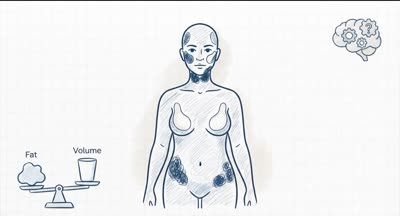
Fat grafting has a straightforward biological problem. Grafted tissue arrives without a blood supply, and until new capillaries grow into it the fat cells survive on diffusion alone. Published reviews put reported volume retention after autologous fat grafting somewhere between 30% and 80%, a range so wide that it functions less as a benchmark than as a warning: the outcome depends on how the fat was harvested, processed, placed and fed, and on the tissue it was placed into. Cell-assisted lipotransfer is the attempt to narrow that range by adding adipose-derived stem cells to the graft so new vessels form faster. It is the most biologically interesting idea in body contouring, and the published evidence for it is positive on average while being almost perfectly inconsistent.
The short version
- Reported volume retention after autologous fat grafting spans 30% to 80%, which functions as a warning rather than a benchmark.
- A pooled analysis of 15 studies favoured enriched grafts, with a standardised mean difference of 2.44 and heterogeneity of 97.19%.
- That heterogeneity means technique and recipient site, not the enrichment step, drive most of the variation between studies.
- Enrichment effects were largest in facial applications, where the subgroup analysis reported a standardised mean difference of 2.95.
- The source material names low vacuum pressure around 400 mmHg and cannulas near 3 mm as protective for adipocytes.
Why the graft starves, and what the cells do about it
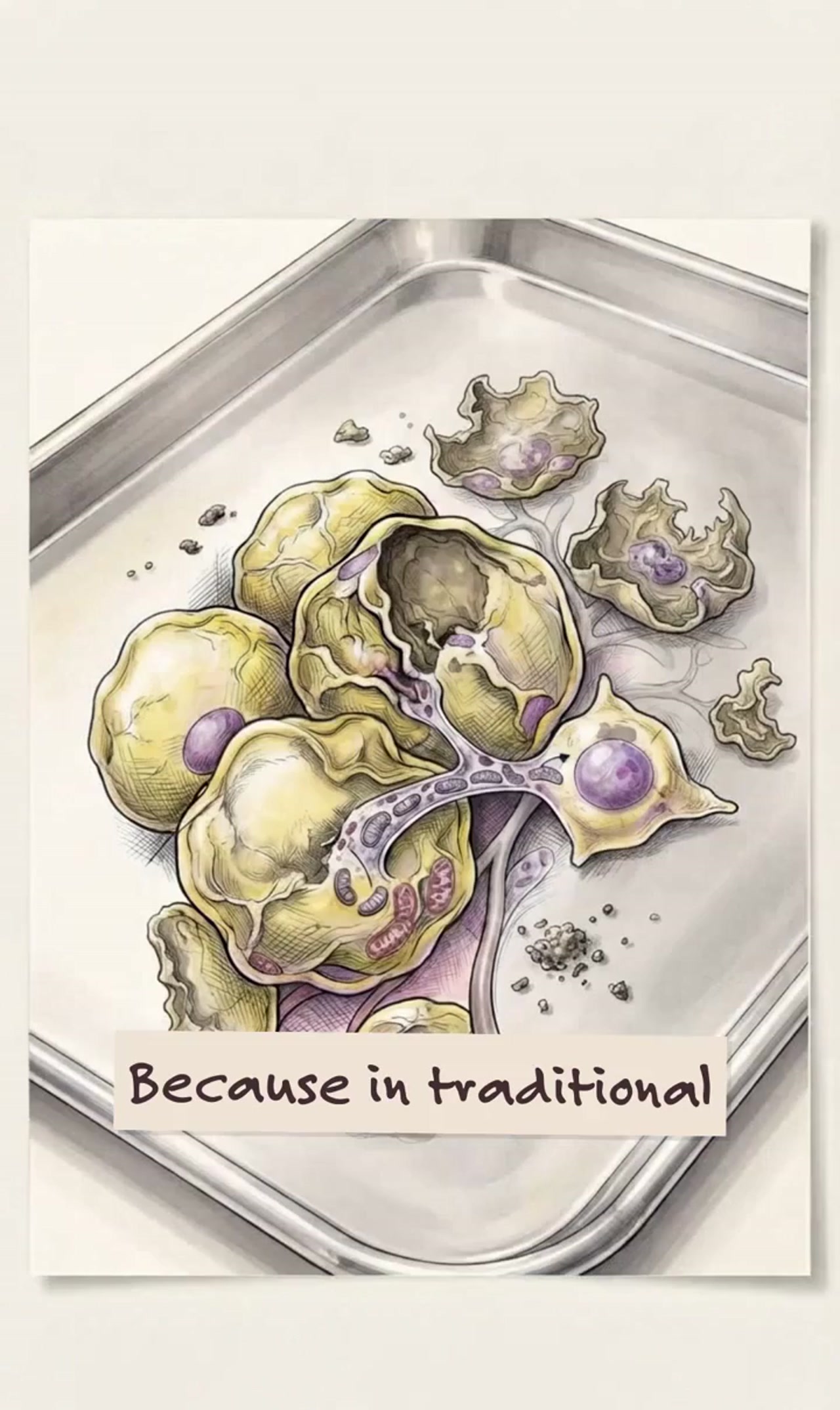
The mechanism is well described in the peer-reviewed literature. Harvesting fat is traumatic: every step — vacuum pressure, cannula diameter, turbulence as the tissue moves through tubing, the way it is spun or filtered, the needle through which it is injected — damages a fraction of the adipocytes. What survives then faces ischaemia until revascularisation, and it is during that window that most of the eventual loss happens. Published biology attributes the rescue effect of graft enrichment to several mechanisms at once: growth-factor secretion that recruits new capillaries, immunomodulation that stops the host from clearing the graft, and mitochondrial and exosomal signalling between cells. That last group is worth knowing about because it distinguishes evidence-based descriptions of the technique from marketing descriptions of it. The notebook material names the mechanisms: growth-factor secretion that recruits new capillaries (VEGF and FGF2), a shift of macrophages toward the anti-inflammatory M2 phenotype that stops the host clearing the graft, and mitochondrial and exosomal signalling between cells — mitochondrial transfer travelling through tunnelling nanotubes.
| Retention driver | Published range or effect | What a patient should ask |
|---|---|---|
| Overall graft retention | 30–80% reported across autologous fat grafting | What is your own measured retention in my area, and how do you measure it? |
| Enrichment with stromal vascular fraction or adipose-derived stem cells | Meta-analysis favours enriched grafts for survival, with extreme heterogeneity between studies | Which preparation, at what cell dose, and what does the added processing cost? |
| Recipient site | Enrichment effects were largest in facial applications in the published subgroup analysis; scarred or irradiated beds behave differently | How much of the expected volume will be taken up by a second session? |
| Follow-up before judging the result | Mean follow-up across the pooled studies was 16.2 months, range 4–84 months | At what point do you call the result final? |
| Clinical applications beyond contouring | Facial rejuvenation with ultra-fine nanofat, structural infraorbital dark-circle correction, softening of radiation-induced scars, and post-mastectomy reconstruction | Which of these is the transfer for, and what does the published evidence cover in that specific recipient bed? |
What the meta-analysis actually reports
The largest recent pooled analysis compared enriched grafts with conventional lipofilling across 15 studies. It found a statistically significant improvement in graft survival favouring the enriched groups, with a standardised mean difference of 2.44 and a confidence interval of 1.00 to 3.88. It also reported heterogeneity of 97.19% — meaning that the studies disagree with each other to nearly the maximum extent the statistic can express. Both numbers are true, and reading them together is the whole point.
| Analysis | Result | Plain reading |
|---|---|---|
| Pooled graft-survival effect, enriched versus conventional | 15 studies; SMD 2.44 (95% CI 1.00–3.88; p = 0.001) | The average effect is favourable and statistically significant. |
| Consistency between studies | I² = 97.19% | The average is a poor prediction for any single case: technique and site drive the variation. |
| Subgroup: facial applications | SMD 2.95 | The strongest signal is where small volumes and rich vascularity help. |
| Subgroup: water-assisted harvesting | No significant added benefit from enrichment | If the harvest already preserves cells well, the enrichment step may add little. |
| Cell preparation and purity | Uncultured stromal vascular fraction: a fresh mix in which roughly 1–10% of cells are stem or stromal cells. Culture-expanded adipose-derived stem cells: grown under GMP conditions to greater than 90% purity | The meta-analyses attribute the larger retention gains to the expanded preparation — and that is also what raises the regulatory and cost burden |
Two practical conclusions follow. First, enrichment is not a uniform upgrade; it interacts with how the fat was obtained and where it is going. A clinic that offers cell-assisted transfer for a buttock augmentation as confidently as for facial volume is not reading its own literature. Second, the confidence interval spanning 1.00 to 3.88 means the benefit could be marginal. A patient paying a premium for the cell step is paying for a probability, not a guarantee, and the honest question is what the incremental cost buys in retention terms. The next step in the same direction is cell-free: exosome preparations that carry the signalling without living cells, which the notebook material describes as an outlook rather than an established option.
Harvest and handling: where the retention is actually won or lost
Because the graft's fate is decided before it is placed, the handling variables are the ones worth interrogating. Published technique comparisons have measured several of them, with results that contradict some common assumptions.
| Handling variable | Published finding | Strength of evidence | Question to ask |
|---|---|---|---|
| Aspiration pressure and shear | Vacuum-based suction generates variable sub-atmospheric pressures and can introduce turbulence and shear forces that affect adipocyte viability; a closed-circuit peristaltic technique is described as an alternative across more than 160 procedures | Technique report and mechanistic review; no head-to-head retention trial | What pressure do you harvest at, and is it measured? |
| Cannula diameter | Larger cannulas have been associated with a higher stromal vascular fraction content in the harvest, against the older assumption that smaller particles survive better | Laboratory study on harvested lipoaspirate | What cannula size do you harvest and inject with? |
| Processing method | Filtration, centrifugation and emulsification into nanofat are all described; processing determines cell content as much as volume | Widely reported, variably compared | Which method, and why that one for my area? |
| Placing the graft | Layering in small aliquots is the standard described technique; concentrated boluses increase the risk of oil cysts and fat necrosis | Consistent in technique descriptions | How will the fat be layered, and what happens if a collection forms? |
The source material behind this article states the protective range directly: low vacuum pressure of roughly 400 mmHg with harvesting cannulas around 3 mm, on the reasoning that gentler handling keeps more adipocytes intact. It puts the stakes at the same scale and in the same place — in conventional transfers as much as 80% of the transferred fat is lost.
Safety, regulation, and the questions that keep it honest
Three safety conversations surround fat transfer, and each has a documented basis. The first is oncological: fat grafting in the breast has been studied specifically for this concern, and the pooled BREAST-I and BREAST-II follow-up established oncological safety in the reconstruction setting while noting that pre-operative risk screening remains part of the assessment. The second is regulatory: autologous fat used in the same operation sits differently in US regulation from concentrates and culture-expanded cell preparations, and published reviews of fat-grafting regulation describe the FDA's concern about oncological potential and interference with breast-cancer imaging. The third is technical: fat necrosis and oil cysts are the failure modes of grafts placed too thickly, which is why layering appears in every published technique description.
The questions that separate a clinical offer from a sales one are specific: what preparation of cells, at what dose, from what tissue, processed where, and with what added cost — plus how the result will be measured. Where a surgeon proposes breast or buttock transfer, the screening, imaging and follow-up plan belongs in the same conversation, and the general credential checks in our five-step verification pass are the starting point.
For the surrounding decisions, three of our guides carry the detail. The volume and safety limits of a session are set out in how much fat can be removed in one session; the difference between removing fat and moving it is in liposuction versus a tummy tuck and body contouring; and the published complication rates that apply to the harvest half of any transfer are collected in the published rates article. The recovery shape after transfer matches any other liposuction case and is set out in the week-by-week timeline and the compression and lymphatic care guide, and the aftercare questions are in section eight of the 50-question consultation checklist. Cost components — including whether a cell-processing step is itemised separately — belong in the same itemised quote discussed in our fee breakdown.
One last framing point. Where the fat goes matters more than the label on the process: a 30% retention in a small facial graft is a different problem from a 30% loss in a buttock transfer where volume was the point. Ask what proportion of transferred volume is expected to survive, at what follow-up interval that figure is measured, and what the plan is if it does not. Any surgeon who can answer those three questions numerically is working from the same data as the reviews cited above.
It also helps to know what transfer does not do. Fat grafting adds volume; it does not tighten skin, and it does not correct the loose envelope that often prompted the consultation in the first place. When a plan proposes transfer to a lax area, the ordering question is whether an excision would serve the contour better, and that is a question about skin rather than about cells. Our guide to energy-based skin tightening and its thermal limits sets out what the tightening half of that conversation can and cannot deliver.
Frequently asked questions
What percentage of fat survives after fat grafting?
Published reviews put reported volume retention after autologous fat grafting somewhere between 30% and 80%, a range wide enough to act as a warning rather than a benchmark. The outcome depends on how the fat was harvested, processed, placed and fed, and on the recipient tissue.
Does enriching a fat graft with cells improve its survival in the published evidence?
On average, yes. A pooled analysis of 15 studies found enriched grafts survived better, with a standardised mean difference of 2.44, but heterogeneity was 97.19%, so the average is a poor prediction for any single case. The confidence interval spanned 1.00 to 3.88.
Which harvesting variables decide how much of a fat graft survives?
The source material names low vacuum pressure of roughly 400 mmHg and harvesting cannulas around 3 mm as protective. Larger cannulas have been associated with a higher stromal vascular fraction content, and layering the graft in small aliquots avoids the oil cysts and fat necrosis that concentrated boluses risk.
Sources
Published figures as of the access date (12 Sep 2026). Notebook basis: the notebook research set behind this pack supplied the survival framework (graft ischaemia, cell enrichment, layering, retention expectations); every number below is checked against the published source listed with it, and the harvest-pressure and cannula figures are reproduced as the notebook material states them (roughly 400 mmHg and about 3 mm).
1. Sutar et al., Clinical Efficacy of Adipose-Derived Stem Cell-Enriched Lipotransfer Versus Conventional Fat Grafting: A Systematic Review and Meta-Analysis, 2026 (15 studies; SMD 2.44, 95% CI 1.00–3.88; I² = 97.19%; facial SMD 2.95; water-assisted subgroup without added benefit; mean follow-up 16.2 months) — https://pmc.ncbi.nlm.nih.gov/articles/PMC13090857/
2. Advancing fat graft survival: from adipose-derived stem cell mechanisms to next-generation regenerative strategies, Frontiers in Cell and Developmental Biology 2026 (retention range 30–80%; stromal vascular fraction approximately 1–10% adipose-derived stem/stromal cells) — https://pubmed.ncbi.nlm.nih.gov/42388980/
3. Peristaltic Pump-Assisted Fat Harvesting and Closed-Circuit Grafting, Aesthetic Surgery Journal Open Forum 2026 (vacuum systems generate variable sub-atmospheric pressures and shear; more than 160 procedures) — https://pubmed.ncbi.nlm.nih.gov/42582544/
4. Cannula Size Effect on Stromal Vascular Fraction Content of Fat Grafts, Plastic and Reconstructive Surgery Global Open 2021 (larger cannulas associated with higher SVF content) — https://pubmed.ncbi.nlm.nih.gov/33907655/
5. Safety and Regulation of Fat Grafting, peer-reviewed review (FDA concerns regarding oncological potential and interference with breast-cancer screening; regulatory history) — https://pmc.ncbi.nlm.nih.gov/articles/PMC7023970/
6. BREAST-I and BREAST-II pooled follow-up, Establishing oncological safety of autologous fat transfer for total breast reconstruction, European Journal of Surgical Oncology 2026 — https://www.ejso.com/article/S0748-7983(26)00036-3/fulltext
7. ASPS Practice Advisory on Liposuction: Executive Summary (serial procedures, fluid management, facility criteria) — https://www.plasticsurgery.org/documents/medical-professionals/health-policy/key-issues/executive-summary-on-liposuction.pdf
8. Comerci AJ, et al., Risks and Complications Rate in Liposuction: A Systematic Review, Aesthetic Surgery Journal 2024 (pooled local complication rates including seroma and fat necrosis) — https://pubmed.ncbi.nlm.nih.gov/38563572/
9. Systematic review of contemporary liposuction techniques, Frontiers in Surgery 2026 — https://frontiersin.org/articles/10.3389/fsurg.2026.1892614/full
10. US FDA device classification, suction lipoplasty system, 21 CFR 878.5040, Class II, product code QPB — https://www.accessdata.fda.gov/scripts/cdrh/cfdocs/cfpcd/classification.cfm?ID=QPB
Medical-safety note: retention and safety figures above are population results from published studies, not a forecast for any individual, and no fat-grafting technique can guarantee a volume outcome. Only a board-certified plastic surgeon who examines you can determine whether fat transfer is appropriate for you, and any breast procedure should include the screening and follow-up that the published safety literature requires.